Expand All Topics | Close All Topics
Overview
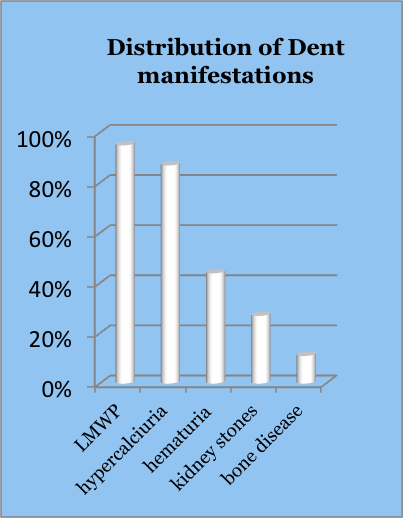
Dent disease (Dent's disease) is a rare genetic disease that affects the kidneys of mostly male patients, although females can also have mild manifestations of the disease. Typical problems include:
Spillage of small proteins into the urine
High levels of calcium in the urine (hypercalciuria)
Calcification of the kidneys (nephrocalcinosis)
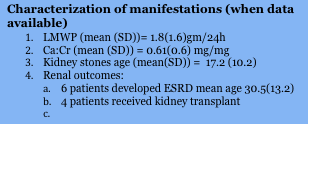
Chronic kidney disease (CKD)
Kidney Stones
Hematuria (small or large amounts of blood in the urine)
Low levels of phosphorous in the blood (hypophosphatemia)
The clinical course varies greatly between affected persons, even within the same family.
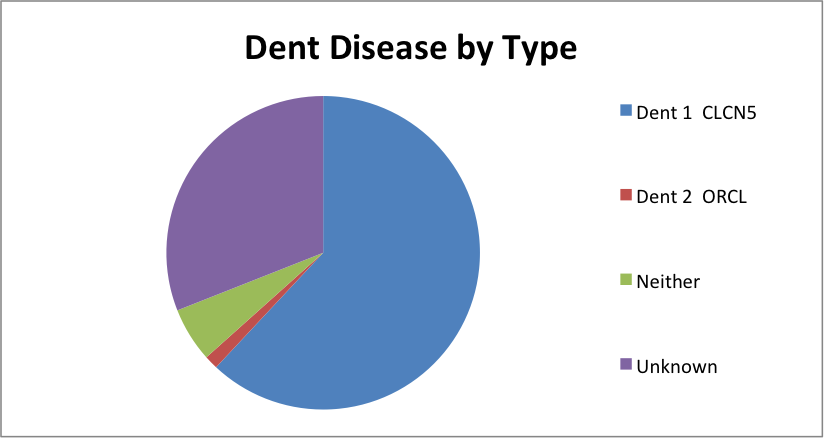
Dent disease can be divided into 2 types: Dent 1 and Dent 2. Research has identified two genes on the X-chromosome that can cause Dent disease. The type of the genetic change determines which type of Dent disease a patient has.
Dent 1 has a mutation (change) in the gene named CLCN5 and approximately 60% of patients with Dent disease will have this mutation. Dent 2 has a mutation in the gene OCRL and approximately 15% of those with Dent disease will have this mutation. Molecular (DNA) genetic testing for both genes is currently available. This test is requires a blood test.
OCRL mutations are also known to cause another syndrome called Lowe syndrome. Lowe syndrome mostly affects the eyes, brain, and kidneys and occurs almost exclusively in males Kidney manifestations in patients with Lowe syndrome are very similar to those with Dent disease. However, patients with Dent disease 2 typically have mostly kidney abnormalities and specifically lack certain key features of Lowe Syndrome such as dense cataracts and cognitive impairment.
In addition, in recent years much has been learned regarding the genes that cause Dent disease and Lowe Syndrome However, the exact mechanism(s) whereby the defective CIC-5 cotransporter activity or defective OCRL gene product cause disease are not currently understood, and are a hot topic of ongoing research. Small differences between Dent Disease type 1 and type 2 patients may provide clues to better understanding the unique pathogenesis of each type of the disease.
More detailed information regarding Dent Disease research is available in the Disease Information for Physicians section.
Signs and Symptoms
The most common symptoms that patients with Dent's disease experience are related to the passage of kidney stones, such as pain or blood in the urine. Some patients can have foamy urine (a manifestation of proteinuria) and increased thirst. If patients develop renal failure, they can have signs and symptoms related to loss of kidney function that include anemia, fatigue, loss of appetite and weight. If patients develop osteomalacia (weak bones) they might experience boney pain.
Diagnosis
A physician may suspect Dent Disease by observing a number of clinical markers including but not limited to
Protein in the urine
Kidney calcifications (nephrocalcinosis)
Calcium oxalate and/or calcium phosphate kidney stones
Excessive levels of calcium in the urine
Excessive urinary amino acid excretion
Reduced levels of parathyroid hormone in the blood
Reduced levels of parathyroid hormone in the blood
Increased levels of vitamin D
Bone deformities (Rickets)
Short stature/growth delay
A definitive diagnosis can be made by genetic blood testing of the patient. If the patient's genetic material includes Dent Disease-specific mutations, the diagnosis is confirmed.
As part of our research protocol, we now perform CLCN5 and OCRL genetic testing for patients and family members at risk of having the disease or being carriers.
More detailed information regarding the specifics of diagnosis is available in the Disease Information for Physicians section.
Treatments
Treatment efforts are targeted to reducing kidney scarring and preventing kidney failure associated with Dent Disease. Unfortunately, the mechanisms by which these outcomes occur are poorly understood, and no treatment trials are available to help physicians choose the best therapy. Available recommendations come from those doctors with the most experience caring for these patients. Since we assume that kidney calcification and kidney stones are caused by the high levels of calcium in the urine, treatment typically is targeted at reducing those levels. This is commonly achieved by administering a thiazide diuretic to increase renal calcium reabsorption and thereby reduce levels of calcium in the final urine. While these drugs have been shown to reduce levels of calcium in the urine of Dent disease patients, no information is available whether or not this can reduce the number of stones or protect kidney function.
Studies in an animal model have suggested that a high citrate diet may delay the loss of kidney function. However there is no data on the use of citrate-containing medications in human patients with Dent disease.
For Dent disease patients with osteomalacia (weak bones) vitamin D and related compounds have been used, apparently improving bone strength. However, use of vitamin D may also increase levels of calcium in the urine which might worsen kidney function or cause kidney stones, so its use must be carefully monitored.
One of the main characteristics of Dent disease is increased protein in the urine, which is the result of abnormal function of the kidney tubules. This type of protein is called low molecular weight protein. Dent disease patients can also develop changes in their filtering units (glomeruli) and leak albumin into the urine. Therefore medications called angiotensin converting enzyme (ACE) inhibitors or angiotensin receptor blockers (ARB) might be useful, since these medications are used in other kidney diseases to reduce the level of albumin in the urine. However it is currently not known how successful these medications are for reducing the progression of Dent disease.
Patients with Dent disease report they tend to be thirsty and make increased amounts of urine. Because of that, they may be particularly sensitive to any conditions that can cause dehydration like diarrhea, vomiting, and increased sweating in hot weather. Therefore, Dent disease patients should pay particular attention to their fluid intake when they are at risk of dehydration.
Dent patients should also be careful to limit use of non-steroid anti-inflammatory medications (NSAIDs) like ibuprofen, (motrin, advil), naprosyn, indomethacin, sulindac, since they tend to reduce renal blood flow when persons become dehydrated.
Dent patients that do develop renal failure have been given kidney transplants with good success.
Research
The main focus of the Dent Disease Research Program is the following:
To establish and expand a Dent Disease Registry. The purpose of this registry is to identify as many affected individuals as possible worldwide, and to collect as much clinical information about these patients as is possible. The resulting collection of data will be much larger than any individual center could hope to accumulate, and will be available to all interested physicians and researchers internationally.
You can help the research by participating in the Dent Disease Registry! Contact our Study Coordinators and they will help you with all the details!
To develop Biobank or Repository, (a facility that collects and stores samples of biological materials like blood, urine, tissue or cells for laboratory research) of the specimens. The purpose of this study is to make samples available for use in research of Dent disease.
To design clinical trials and observational studies that will advance knowledge and research of Dent disease to provide better evidence for current treatment and create new ideas in treating and improving lives of patients with Dent disease
Active study: "Screening For Dent Disease Mutations In Patients With Proteinuria"
For more information contact the RKSC Study Coordinators at:
Email: rarekidneystones@mayo.edu
Phone: 800-270-4637
Or go to http://rarediseasesnetwork.epi.usf.edu/RKSC/studies
Publication list
A. Review papers
Genetic causes of kidney stones and kidney failure. Lada Beara-Lasic , Vidar O. Edvardsson, Runolfur Palsson, John C. Lieske, David S. Goldfarb and Dawn S. Milliner. Clinical Reviews in Bone and Mineral Metabolism, January 2012.
Hereditary causes of kidney stones and chronic kidney disease. Edvardsson VO, Goldfarb DS, Lieske JC, Beara-Lasic L, Anglani F, Milliner DS, Palsson R. Pediatr Nephrol. 2013 Jan 20. [Epub ahead of print] PubMed PMID: 23334384.
B. Books and Chapters
Lieske JC, Milliner DS, Beara-Lasic L, Rossetti S. Dent Disease. 2012 Aug 09. In: Pagon RA, Bird TD, Dolan CR, Stephens K, Adam MP, editors. GeneReviews™ [Internet]. Seattle (WA): University of Washington, Seattle; 1993-. Available From http://www.ncbi.nlm.nih.gov/books/NBK99494/ PubMed PMID: 22876375.
C. Poster presentations at international meetings
Presenting Characteristics of Dent Disease Patients. John C. Lieske, MD, FASN, Steven J. Scheinman, MD, FASN, Lawrence A. Copelovitch, MD, Hae Il Cheong, MD, PhD, Eric J. Bergstralh, Ramila A. Mehta and Lada Beara Lasic, MD. Annual Meeting of The American Society of Nephrology, November 2012, San Diego, CA.
Registry
Due to the rarity of Dent disease, physicians will typically have only limited experience with Dent Disease patients over the course of a normal practice. In an effort to unify international research efforts and centralize information, a Dent Disease Registry has been established at the Mayo Clinic. The goal of the registry is to allow the development of consensus, evidence-based guidelines for the diagnosis and management of Dent Disease, and identify patient cohorts for clinical trials. By making this data available to the appropriate clinicians and biomedical researchers, new ideas can be tested and research progress can be made on an accelerated cooperative scale.
Patients in
Registry |
Age at diagnosis
mean years
|
Diagnosed after age 20 (%) |
Type of mutation |
105
|
15
|
20 (21%)
|
CLCN5 (Dent 1) 78
OCRL (Dent 2) 7
Non 1, Non 2 10
Unknown 10
|
To learn more about the Dent Disease registry at the Mayo Clinic, please contact the Rare Kidney Stone Consortium Study Coordinators at (800) 270-4637 or rarekidneystones@mayo.edu.
Resources
Dent Disease Patient Advocacy Group
New Patient Advocacy Group (PAG) for Dent Disease patients and families has been formed! It is exciting that Catherine and Austin Forrest are in the process of starting this patient group! They have a web page started and all interested patients, family members, physicians, researchers are invited to participate! Check out the new website under development: http://dentdisease.com/
Lowe Syndrome Association
A subset of Lowe Syndrome patients has urinary findings similar to Dent Disease, and the Lowe Syndrome Association (LSA) is very active.
The LSA is an international voluntary non-profit organization made up of parents, professionals and friends. The LSA is dedicated to helping children with Lowe syndrome and their families. The primary purposes of the LSA are to provide information, foster communication among families, and encourage and support medical research. Major activities include publishing a newsletter (On the Beam) and an informational booklet (Living with Lowe Syndrome: A guide for Families, Friends and Professionals), sponsoring conferences every two years, and awarding medical research grants. The LSA has a previous history of collaboration with the RKSC's Primary Hyperoxaluria registry. In 2006 members of the association visited Mayo Clinic to learn first hand processes that were used to establish the Primary Hyperoxaluria Registry. Plans are to adapt these processes for a Lowe's syndrome registry. Since a subset of patients with OCRL1 mutations have Lowe's syndrome, while others have Dent disease, it seems likely that underlying pathophysiologic processes may be common for both. Therefore, the LSA enthusiastically supports our Dent disease Registry. They will promote our Registry via their active web page, newsletter, and annual meetings. As the science evolves, it is possible our efforts may become even more closely aligned.
http://www.lowesyndrome.org/
More information
OMIM – Online Mendelian Inheritance in Man
http://omim.org
Contact information:
Mailing address for records/paperwork:
Mayo Clinic
200 First Street SW
Rochester, MN 55905
Dent Disease Program Ei-SL 33
Email: rarekidneystones@mayo.edu
Phone: 800-270-4637
Fax: 507-255-0770


 Patient Advocacy Group
  | Mayo Clinic, Rochester, MN

 Consortium Home
 Dent Disease